Author: Neel Dev, Hybrid Cloud and Data Presales Technical Director
How to buy with fewer surprises when component costs and logistics keep moving
2026 is seeing a perfect storm of disruptive forces, from the impacts of mergers and acquisitions across the IT software space, to supply chain challenges caused by the AI boom, and more recently, disruption in the Middle East.
From what we are hearing from vendors and the supply chain, these are not short-term problems. The supply chain issues caused by the AI boom are not likely to fully resolve themselves for the rest of 2026 and very likely even much of 2027.
How does an organisation come up with an IT infrastructure roadmap and an operating model in times of such disruption? We have been working with our customers from multiple verticals on this problem and, while there is no silver bullet, there are steps that can be taken to minimise disruption. Memory pricing is also under significant upward pressure right now, and logistics risk has returned to the boardroom, with war-related surcharges and insurance disruption on certain routes adding further uncertainty.
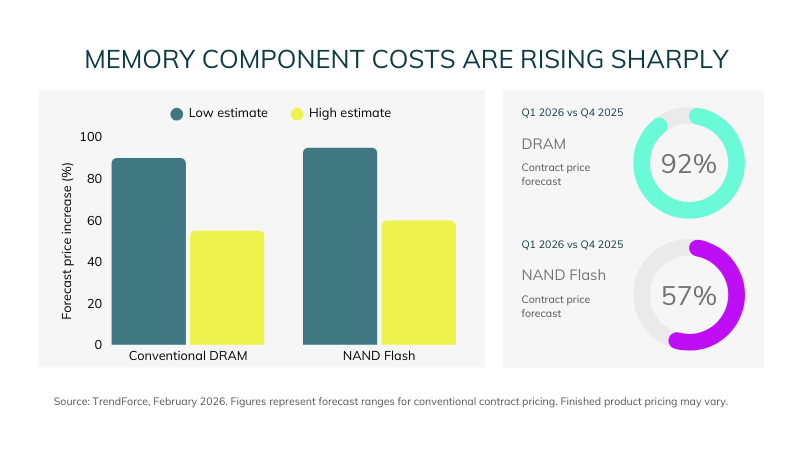
Here are five things to consider before your next technology purchase.
Executive summary for busy readers
The five things to check before your next technology purchase are:
1. Keep options open: why a distributed procurement plan reduces supply chain exposure
2. Think hybrid: how spreading workloads between on-premises and cloud protects your programme when hardware delivery slips
3. Think serverless: why containerising key applications gives you more flexibility across infrastructure routes
4. Move to an orchestrator mindset: how planning 18 to 24 months ahead changes your exposure to supply chain volatility
5. Sweat assets sensibly: when extending hardware life is a deliberate strategy and how to do it safely
1) Keep Options Open
The one thing we have not been starved of in the last decade or so is choice when it comes to IT solutions. The rise of cloud and Software Defined Data Centre has meant that the old datacentre paradigms were already changing before AI came to the fore. IT suppliers now offer approaches like Composable Infrastructure and Disaggregated Infrastructure, meaning organisations are no longer locked into a single hardware stack.
The traditional approach to datacentre procurement was to buy as much from one vendor as possible so there is one throat to choke, and this keeps things simple. With the supply chain crisis caused by the AI boom, however, enterprise hardware providers each have their pros and cons. One of our main storage partners, for example, has less exposure to shortages in the global supply of DRAM and NAND because they do not have to cater to PC users. Another main partner manufactures PCs, laptops, servers and storage across a much wider product range; they have a massive supply chain with significant spread and options, but even large vendors are now having to pass memory costs on to customers.
What a distributed procurement plan looks like
- Identify two or more viable x86 server providers rather than relying on a single route.
- Do the same for storage, where supply constraints and pricing differ significantly between vendors.
Why this matters now
A distributed procurement plan spreads risk across vendors and routes. When one tightens, the others give you room to move. In the current environment, that flexibility is not a nice to have; it is the difference between a project that delivers on time and one that stalls waiting for a single constrained component.
2. Think Hybrid
Another way to think of a distributed procurement strategy is to spread workloads between on-premises technologies and public cloud. Many organisations run cloud and on-premises workloads as isolated siloes, leading to duplication and spiralling costs. Two separate skill sets are required to manage a VMware environment and an Azure or AWS one, which compounds the problem.
With options like Azure Local and AWS Outpost, customers can now manage on-premises appliances and public cloud from a single pane of glass. Tools like Azure Arc go further, managing not only on-premises workloads but those running in Azure, AWS and GCP simultaneously. Having a dependable, secure cloud footprint means workloads can be moved to cloud in times of hardware shortages on premises, further spreading risk across platforms.
How hybrid reduces supply chain exposure
- A cloud footprint acts as a buffer: if on-premises hardware delivery slips, workloads can move to cloud without a full platform rethink.
- Managing both environments from a single pane of glass reduces the operational overhead that often makes hybrid feel too complex to maintain.
- Spreading workloads across on-premises and cloud also diversifies your commercial exposure; cost increases are hitting on-premises hardware harder than public cloud in the current cycle.
- Hyperscalers have significant untapped infrastructure available via IaaS and PaaS. While some regions have seen demand pressure, capacity options across Europe remain accessible.
- Public cloud cost increases are coming, but are not yet at the 30 to 50 percent levels being seen in some on-premises hardware categories.
3) Think Serverless
The acquisition of Red Hat by IBM and the introduction of tools like Tanzu from VMware show how critical container technologies are becoming in hybrid environments. Unlike VMs, containers can be much more portable between on-premises and cloud, and between public clouds. Integrating plans to containerise key applications allows organisations to leverage the full range of options in the market today, reducing dependency on any single infrastructure route.
Portability between environments is a risk-control decision as much as a technical one. A workload that can move is a workload that is not held hostage to a hardware delay. Containerisation also reduces the skills overhead of managing separate on-premises and cloud environments, which compounds the cost saving from a hybrid model. Planning containerisation as part of the infrastructure roadmap now gives organisations more flexibility to respond to supply constraints as they develop.
4) Move from a reactive procurement model to a proactive, orchestrator mindset
With fulfilment of hardware starting to roll into weeks and months, it is vital that organisations plan out the next 18 to 24 months with a procurement strategy that ties in with the technical roadmap.
Organisations should look to pull forward procurement where it is appropriate. Supply chains are unlikely to return to normal before at least the second half of 2027, and they may worsen before they recover. Why wait until October 2027 for a hardware refresh that could be ordered now? Like flights and hotels, costs and lead times will only worsen across the year. If more storage or compute is needed for a project in June, placing the order now rather than 4 to 6 weeks ahead of the implementation date is the smarter move.
What an orchestrator procurement plan includes
- Map planned projects against hardware requirements for the next 18 to 24 months and identify where demand will fall.
- Pull forward procurement on known requirements rather than waiting for the standard refresh cycle.
- Plan for long delivery timescales from the outset: most vendors are already operating on extended lead times.
- Treat procurement planning as a strategic function, not a reactive one. The organisations managing this best are running procurement and technical roadmaps in lockstep.
The organisations we are working with that are managing disruption best are not reacting to it. They planned 18 months ahead and that planning is now paying off.
5) Think about sweating certain assets
There are third-party solutions that allow organisations to keep hardware under support and performant for longer than the standard 3 to 5 year lifecycle. At Trustmarque and Ultima, we work with best-of-breed providers who can take over an IT estate that is out of support or approaching end of support, swap out components where necessary from an existing ring-fenced inventory, and keep systems running reliably beyond their original refresh date.
We can even work with customers to make existing hardware more efficient by enabling water cooling, where appropriate, even when the hardware was not originally designed for it. With global geopolitical pressures driving power costs up, using less power and external cooling can deliver meaningful savings on operating costs.
Consumption models as an alternative
- Some vendors offer on-premises hardware on a leasing basis, similar in some ways to public cloud. This shifts the burden of catering for growing hardware requirements to the provider rather than the buyer.
- Public cloud is the natural extension of this model. Hyperscalers have significant infrastructure available via IaaS and PaaS. Cost increases are coming to cloud as well, but are not yet at the levels being seen in on-premises hardware.
- For organisations with ageing estates, sweating assets while the supply chain stabilises can be a deliberate and cost-effective strategy rather than a compromise.
- Third-party maintenance providers can often extend support on hardware that the original vendor has end-of-lifed, buying time for a planned refresh rather than a forced one.
Sweating assets is not about cutting corners. Done properly, with the right third-party support and a clear view of risk, it can free up budget and time while the market stabilises.

How to turn this guidance into action
A proactive, flexible procurement strategy is what the current environment requires. It may seem daunting to engage so many different parties and stakeholders in an attempt to mitigate risk, but this is exactly where Trustmarque and Ultima shine. Combined, we can liaise with hardware vendors across the spectrum, as well as hyperscalers and niche third-party providers who can help sweat assets while minimising risk and increasing power and cost efficiency.
We have been able to help multiple customers with tailored procurement and solution roadmaps across this period and have leveraged our broad relationships in the industry to alleviate many infrastructure and supply chain concerns.
FAQs
Why are technology prices rising so quickly?
Component costs, especially memory, can move quickly when demand tightens supply. Those increases flow into pricing, availability, and quote validity across many finished technology products.
Can a supplier change the price after they issue a quote?
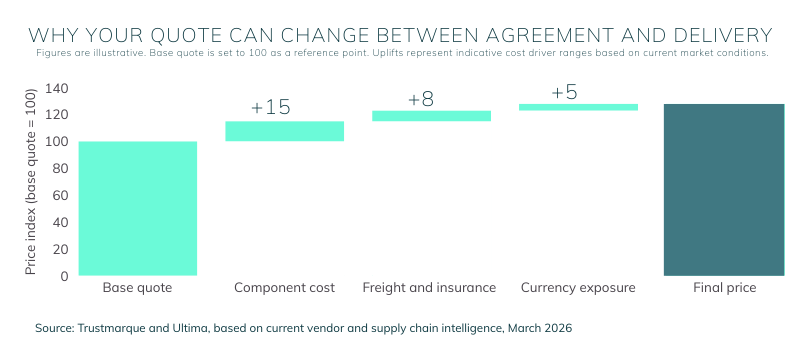
Sometimes, yes. It depends on quote validity and the contract terms, including availability, currency exposure, and substitution clauses. The key is to check whether price is fixed through delivery or only until the quote expiry date.
What is the fastest way to reduce risk before signing a PO?
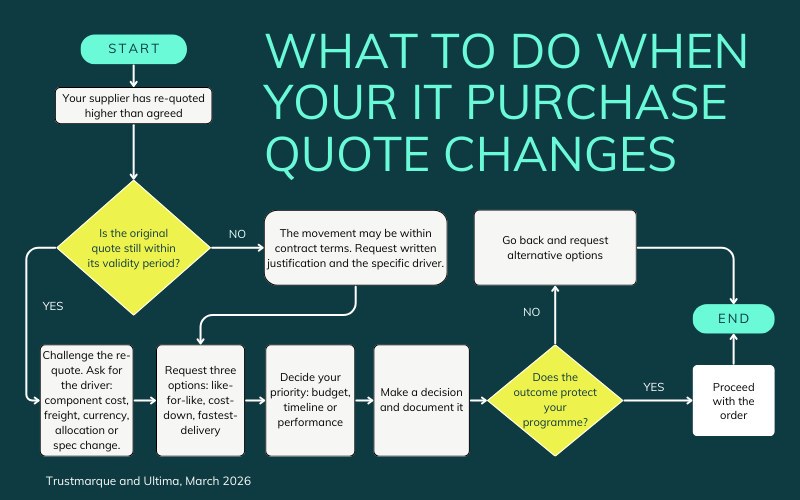
Ask for three options for the same requirement: like-for-like, cost-down, and fastest-delivery. Then confirm what the quote protects, what could change, and what happens if lead time slips.
Should we buy now or wait?
The better question is whether waiting increases risk elsewhere, such as project slippage, operational exposure, or missed transformation milestones. Many teams reduce risk by phasing purchases and keeping alternatives ready, rather than pausing entirely.
What should we do if a quote changes unexpectedly?
Start by checking quote validity and contract terms. Then request a clear explanation of the driver, and ask for alternatives. Decide what matters most, budget, timeline, or performance, and trade intentionally.
Sources: