Why Data Readiness, Not AI, Will Define the Next Generation of Business Success
How Microsoft Fabric, OneLake and modern data foundations are helping organisations unlock AI at scale Artificial intelligence dominates today's techn...
For the last 18 months, most organisations have talked about AI through the lens of personal productivity.
Copilot drafts emails faster. Copilot summarises meetings. Copilot helps people “do their job a bit better”.
Useful? Absolutely.
Transformational? Not yet.
What’s starting to change now is where the intelligence lives.
Microsoft’s shift from Copilot‑led assistance to agent‑led automation marks a much more significant moment for enterprise AI, and it’s one customers are beginning to take seriously. Not because agents are new, but because Agent 365 finally makes them governable at scale.
And that matters more than hype.
In customer conversations today, the tone has changed.
The question is no longer “What can Copilot do?”
It’s “Where can we safely let AI act?”
That difference is subtle… but crucial.
Copilot Agents, now generally available to Microsoft 365 Copilot customers, allow users to build no‑code agents directly in Copilot Chat or Teams. These agents can retrieve knowledge, automate simple workflows, and assist with repeatable tasks, all governed by existing Microsoft 365 security and compliance controls.
This is where many organisations are currently experimenting:
The experimentation phase is real. But so is the hesitation.
Because without central control, agents quickly become the new macros: useful, fragile, and poorly understood at scale.
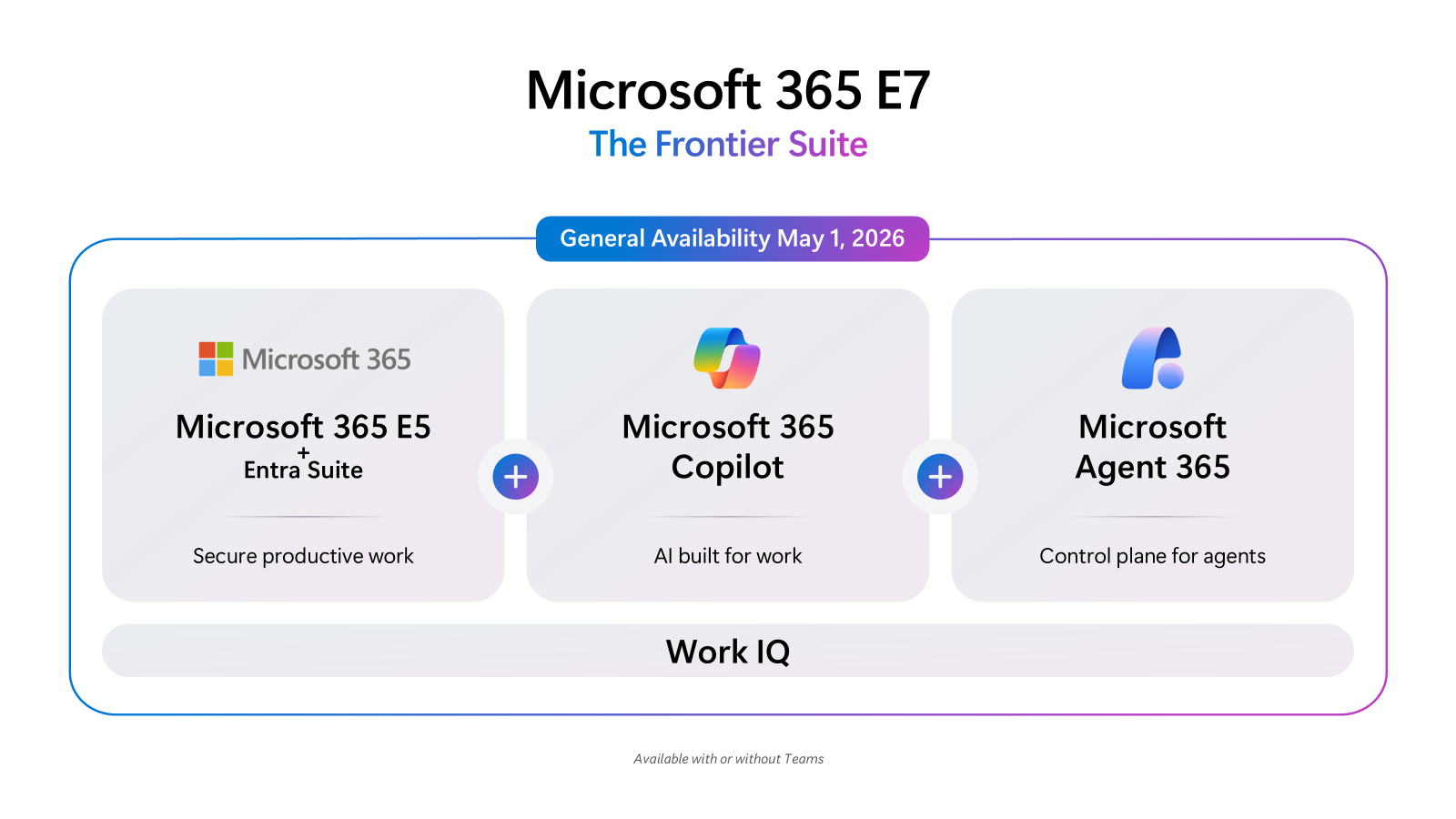
Agent 365, Microsoft’s new enterprise control plane for AI agents, is where things move from enthusiasm to intent.
Available from 1 May 2026 and included as part of Microsoft 365 E7 (Frontier Suite), Agent 365 isn’t about creating agents. It’s about owning them.
For the first time, organisations can centrally manage:
This matters because AI at scale is not a UX problem… it’s an operating model problem.
Most customers aren’t struggling to imagine use cases.
They’re struggling to answer questions like:
Agent 365 is Microsoft’s acknowledgement that AI governance can’t be bolted on afterwards.
There’s a reason interest is accelerating now.
Agents move organisations beyond “help me think” into “help us operate”.
Customers exploring agent‑led models are focusing on:
This is where AI starts to touch cost, risk, and service quality, not just time saved.
And it’s why IT and digital leaders are paying closer attention.
Because once agents can act, the organisation needs clarity on who is responsible for those actions.

Despite the excitement, confidence is mixed, and for good reason.
The biggest blockers we see are not technical. They’re organisational:
1. Licensing confusion
Agent capability now spans Copilot, Copilot Agents, and Agent 365 within E7. Customers are trying to understand:
2. Data exposure anxiety
Agents amplify data access. Without clear controls, customers fear:
3. No clear ownership model
Is an agent:
If nobody owns it, nobody governs it.
These concerns aren’t resistance. They’re signals of maturity.
The organisations moving fastest aren’t chasing the most agents, they’re building the right foundations.
Agent readiness is becoming a priority alongside Zero Trust, identity, and data governance. It brings together:
This is the difference between allowing innovation and scaling it.
Copilot improves how people work.
Agents change how work gets done.
The leap from assistance to automation is where:
Agent 365 doesn’t make AI more exciting. It makes it usable at enterprise scale.
That’s why this moment matters.
Not because agents are clever, but because organisations are finally being given the tools to adopt them responsibly.
The next phase of AI adoption won’t be led by early adopters or power users.
It will be led by organisations that treat agents as first‑class digital workforce components, not experiments.
And that’s where the real advantage will sit.