What do we mean by Shadow AI?
Shadow AI refers to the use of AI tools, models, or capabilities inside an organisation without formal approval, governance, or oversight from IT or security teams. This might include employees using public AI tools, embedding AI into workflows, or creating copilots and automations outside agreed standards, often with good intent and real productivity gains.
Shadow AI typically emerges because people are trying to solve real problems faster than official processes allow. But while the intent is positive, the lack of visibility, ownership, and controls creates risk as usage scales.
Shadow AI isn’t the problem. It’s the signal.
Across organisations, AI adoption didn’t start with strategy decks or governance frameworks. It started with people under pressure, deadlines looming, and readily available tools that promised to save time. Employees experimented. Teams improvised. Productivity jumped.
This phenomenon, often labelled Shadow AI, is typically framed as a risk. But that misses the point.
Shadow AI is a signal of demand. It tells us people want AI to help them work faster, think better, and remove friction from everyday tasks. Blocking it doesn’t work. Ignoring it is worse. The real issue is what happens next.
Because Shadow AI doesn’t stay small.
When Shadow AI becomes Shadow Agents
The first wave of Shadow AI was largely passive: drafting content, summarising information, answering questions. Helpful, but contained.
The next wave is different.
AI is no longer just responding to prompts. It’s taking actions.
Agents can now:
- Monitor inboxes and triage requests
- Update records across systems
- Trigger workflows
- Make decisions within defined boundaries
And many of these agents are being created organically… inside Teams, Copilot Studio, low code tools, or third party platforms, without central visibility.
This is where Shadow AI becomes Shadow Agents.
Unlike traditional Shadow IT, agents don’t just exist. They act. Without clear ownership, identity, or controls, organisations face a new challenge: automation operating outside governance, security, and compliance guardrails.
The risk isn’t innovation, it’s unmanaged autonomy.
Why governance can’t be an afterthought anymore
For years, organisations tried to govern AI the same way they governed apps: policies, approvals, and periodic reviews. That model breaks down when agents:
- Run continuously
- Interact across multiple systems
- Operate on behalf of users or teams
- Learn and evolve over time
To scale AI safely, organisations need to govern agents the same way they govern people:
- With identity
- With access controls
- With visibility
- With accountability
This is the gap Microsoft is now addressing.

Agent 365: bringing Shadow Agents into the light
Microsoft Agent 365 introduces a control plane for AI agents.
Importantly, Agent 365 allows organisations to govern not only Copilot 365 and Foundry agents, but also third‑party agents operating alongside Microsoft 365.
Instead of managing agents in silos, by tool, by team, or by platform, Agent 365 provides a single way to:
- Discover and inventory agents (including those created organically)
- Assign ownership and sponsorship
- Apply identity and access controls
- Monitor behaviour and usage
- Govern agents consistently across their lifecycle
The goal isn’t to slow innovation. It’s to make safe scale possible.
When organisations can see every agent, understand what it does, and control how it accesses data and systems, Shadow Agents stop being a risk and start becoming assets.
Why Microsoft 365 E7 matters
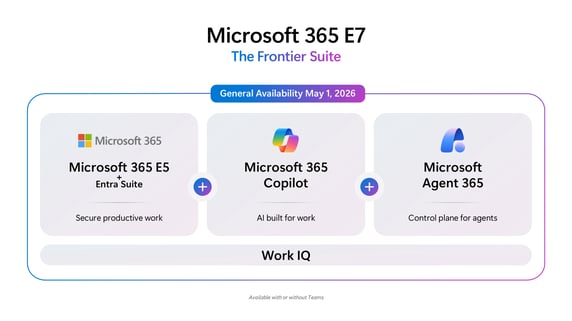
This is where Microsoft 365 E7 changes the conversation.
E7 isn’t simply a new licence tier. It represents a shift in how Microsoft expects organisations to operate in an agentic world.
For the first time, Microsoft has packaged:
- AI productivity (Copilot)
- AI automation (agents)
- Identity (Entra)
- Security, compliance and data protection
into one integrated model, designed for environments where humans and agents work side by side.
Instead of stitching together addons and governance later, E7 assumes from day one that:
- Agents will exist
- They will act
- They must be governed
This makes E7 fundamentally different from previous licensing conversations. It’s not about “adding AI.” It’s about operating AI at scale with trust.
From fear to execution: reframing the Shadow AI narrative
The Shadow AI conversation often starts with fear:
- Data leakage
- Compliance exposure
- Loss of control
But the organisations that move fastest don’t treat Shadow AI as something to shut down. They treat it as intelligence.
They ask:
- Where are people already using AI?
- What problems are they trying to solve?
- Which behaviours should we formalise and scale?
With the right governance foundation, Shadow AI becomes a pipeline for innovation, not a threat.
Agent 365 provides the visibility. E7 provides the operating model.

The real question leaders should be asking
The question is no longer:
“How do we stop Shadow AI?”
It’s:
“How do we turn uncontrolled experimentation into governed execution?”
Because AI adoption is no longer optional, and it’s no longer static. Agents are here. Automation is accelerating. And organisations that can’t see or govern what their AI is doing will struggle to scale it with confidence.
Shadow AI was the warning light.
Governed agents are the way forward.
Want to learn more?
Agent 365 is Microsoft’s emerging control plane for AI agents, designed to give organisations visibility, governance and security over agents that operate across Microsoft 365, Copilot, Copilot Studio and connected third party tools.
In simple terms, Agent 365 helps organisations:
- Understand what agents exist across the tenant (including those created organically)
- See what those agents can access and act upon
- Apply consistent identity, security and governance controls to agent behaviour
- Move from isolated experimentation to enterprise grade, auditable automation
As agents become more autonomous and more deeply embedded into day-to-day work, this layer becomes critical, particularly for organisations operating in regulated or high risk environments.
Trustmarque and Ultima have extensive experience helping organisations design, deploy and govern AI agents, moving from experimentation to secure, scalable execution. If you’d like to understand what Agent 365 and Microsoft 365 E7 could mean for your organisation, speak to your Trustmarque or Ultima account manager to start the conversation.